What Really Happens Chemically When Spray Foam Is Mixed Off-Ratio
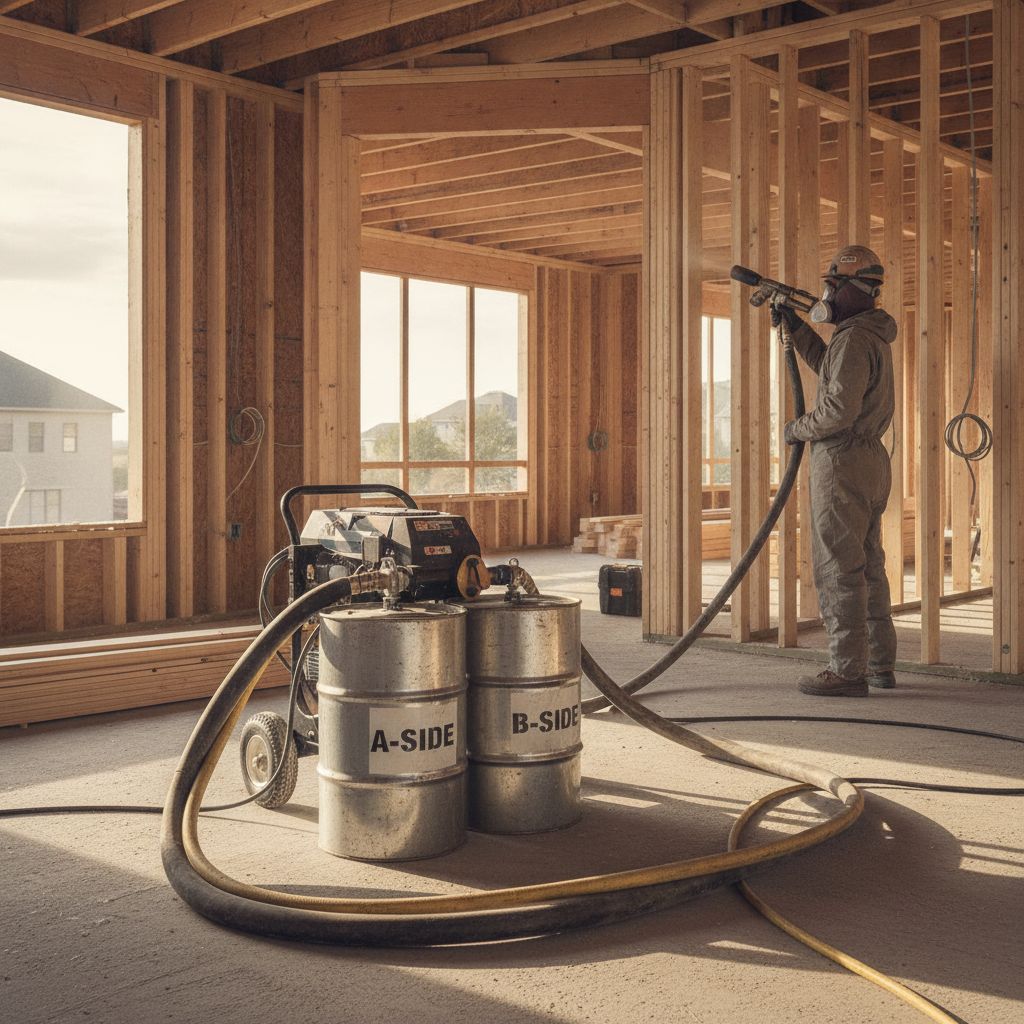
The "off-ratio" explanation for spray foam problems gets used a lot, often without much detail on what's actually happening chemically. The mechanism is specific and well-understood, and knowing it makes it much easier to recognize a bad installation versus a normal one.
The Reaction That's Supposed to Happen
Correctly mixed spray foam combines the A-side (MDI isocyanate) and B-side (polyol resin blend, including catalysts, surfactants, flame retardants, and blowing agent) in close to a 1:1 ratio by volume. The isocyanate reacts with the polyol's hydroxyl groups to form the polyurethane polymer backbone, while a secondary reaction (with water, in open-cell formulations) generates the CO2 gas that expands the foam. Done correctly, this produces a stable, fully-reacted polymer with predictable density, R-value, and physical properties.
What Excess Isocyanate ("A-Rich") Produces
When the proportioner delivers too much A-side relative to B-side, there isn't enough polyol available to react with all the isocyanate present. The excess isocyanate either reacts with ambient moisture in the air (a much slower, less controlled reaction) or remains partially unreacted within the cured foam. The result is a more brittle, friable foam structure that's prone to shrinkage as it continues to slowly cure and off-gas over subsequent days and weeks — which is the specific mechanism behind foam pulling away from framing members after installation, sometimes not becoming visible for weeks.
What Excess Resin ("B-Rich") Produces
The reverse imbalance — too much B-side relative to A-side — leaves excess polyol, catalysts, and other resin-blend components without enough isocyanate to fully react. This tends to produce a softer, tackier cured foam that doesn't reach full hardness, and because unreacted amine catalysts are part of what's left behind, B-rich foam is the more common source of the persistent, sometimes fishy or ammonia-like odor complaints that can last well beyond a normal 24-72 hour cure window.
Why This Happens at the Equipment Level, Not the Chemical Level
Both components are formulated to react correctly at a 1:1 ratio under specified temperature and pressure conditions. The proportioning equipment's job is to deliver exactly that ratio consistently throughout a job — through matched-pressure pumps and heated hoses that keep both components at the right viscosity. Miscalibration, a partially clogged filter on one line, mismatched hose temperatures, or running outside the equipment's rated ambient-temperature range are the actual causes of an off-ratio result. The chemistry itself doesn't fail — the delivery of it does.
What This Means If You Suspect an Off-Ratio Installation
Persistent strong odor well past the normal cure window, visible shrinkage or gapping at seams and framing months after installation, or foam that stays noticeably soft and tacky longer than it should are all reasonable signals to have an installer or independent inspector evaluate the work. None of these are subjective impressions — they're the direct, physical signature of a specific, diagnosable chemical imbalance.
Read the full Off-Ratio & Improper Cure Science guide for the complete picture, including cure-time science and pass-thickness limits.