The Science
Open-Cell vs. Closed-Cell Chemistry
The polyurethane chemistry that separates open-cell and closed-cell spray foam, and what it actually means for performance.
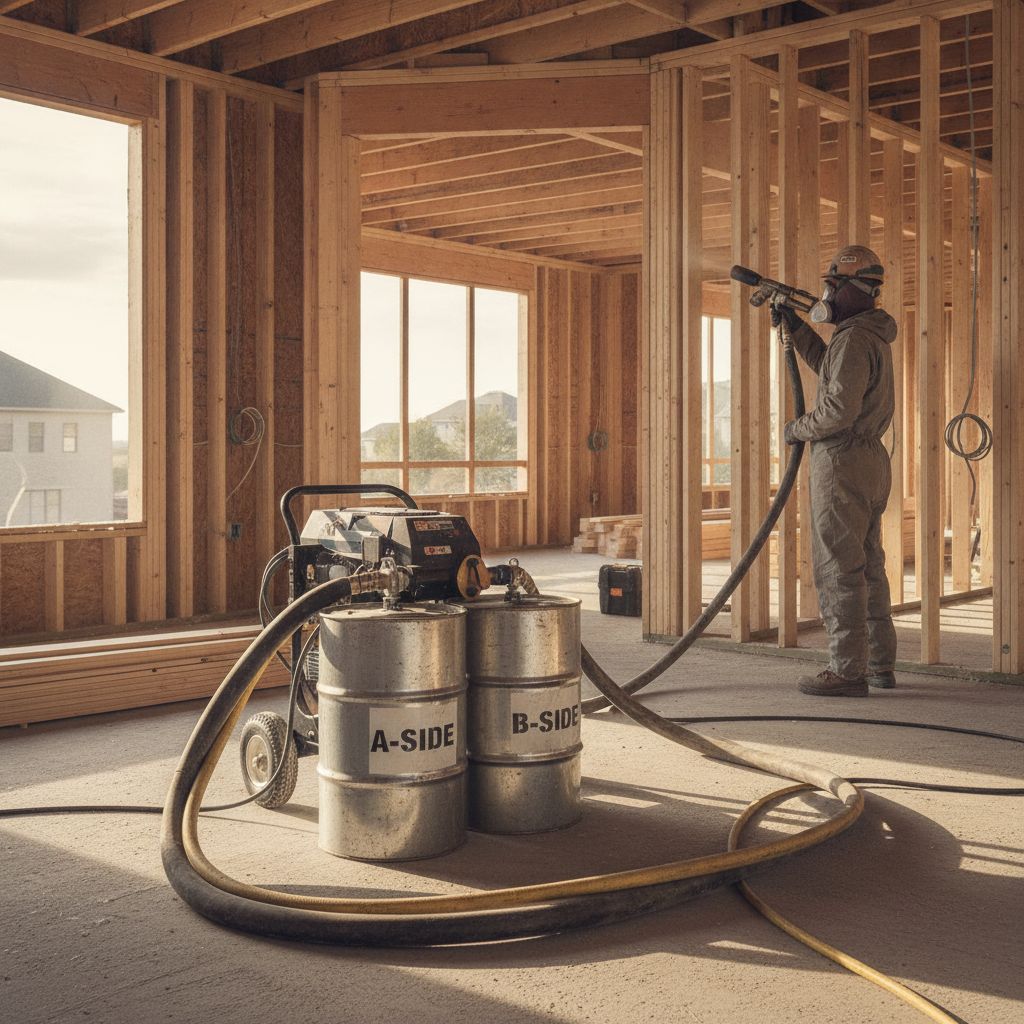
Open-cell and closed-cell spray foam start from the same basic chemistry — a polyol resin blend (the “B-side”) reacting with an isocyanate, almost always MDI (the “A-side”) — but the blowing agent used in that reaction produces two structurally different materials with very different performance profiles. Understanding that difference is the single most useful piece of building science for anyone evaluating a spray foam quote.
The choice between them isn't a matter of one being “better.” It's a matter of which cell structure matches the assembly, climate, and performance goal in front of you.
What the Blowing Agent Actually Does
In open-cell foam, water is typically the primary blowing agent. Water reacts with the isocyanate component in a side reaction that releases carbon dioxide gas, which expands the polymer into a foam structure with cell walls that rupture as they expand — leaving a soft, spongy, open-cell matrix. That ruptured structure is why open-cell foam is air-permeable at the micro level even though it blocks bulk air movement.
Closed-cell foam uses a different blowing agent — typically a hydrofluoroolefin (HFO) in current-generation formulations — that expands into sealed, unruptured gas-filled cells. Those intact cell walls trap the low-conductivity blowing agent gas inside each cell, which is the direct mechanical reason closed-cell foam has a meaningfully higher R-value per inch than open-cell.
Density and Physical Structure
Open-cell foam cures to roughly 0.5 lb per cubic foot — light, flexible, and easily compressed by hand. Closed-cell foam cures to roughly 1.7–2.2 lb per cubic foot, a rigid, dense material that doesn't compress and, at sufficient thickness, adds real racking strength to a wall assembly.
That density difference is not cosmetic. It's the reason closed-cell foam can be used as an air barrier and secondary water-resistive layer in some assemblies where open-cell cannot, and it's the reason closed-cell costs roughly two to three times more per board foot to install.
Vapor Permeability: The Difference That Matters Most for Assembly Design
Open-cell foam is vapor-semi-permeable — generally in the Class III vapor-retarder range (roughly 10–20 perms depending on thickness), meaning it does not stop water vapor from moving through it. Closed-cell foam, once applied at roughly 1.5 inches or more, crosses into Class II vapor-retarder territory (under 1.0 perm), meaning it does functionally block vapor diffusion through the assembly at that thickness.
This single fact drives most of the real engineering decisions in spray foam design — which side of an assembly the vapor control needs to happen on, whether a roof deck can safely dry to the interior or exterior, and whether a given climate zone allows a vapor-impermeable layer in that location at all without trapping moisture on the wrong side.
Which One a Given Assembly Actually Needs
Open-cell is generally the right chemistry for interior wall cavities and unvented attic assemblies in milder or mixed-humid climates where some vapor permeability is desirable, and where the lower material cost matters. Closed-cell is generally the right chemistry for below-grade applications, flood-prone areas, roof decks needing both R-value-per-inch and structural rigidity in limited cavity depth, and any assembly where the vapor-retarder function is doing real engineering work.
A contractor who defaults to one product regardless of the assembly isn't applying chemistry — they're applying inventory. The correct answer is genuinely assembly-specific.
Key Takeaways
- The blowing agent — not the polyol or isocyanate — is what separates open-cell from closed-cell chemistry.
- Closed-cell's higher R-value per inch comes directly from intact, gas-filled cells; open-cell's ruptured cells trade R-value for lower cost and vapor permeability.
- Closed-cell becomes a Class II vapor retarder at roughly 1.5 inches — a real engineering property, not a marketing detail.
- The right product is assembly- and climate-specific, not a universal “better” choice.
Common Questions
Cell Chemistry FAQs
Real questions people ask before starting a spray foam project.
Related Topics
R-Value & Real-World Thermal Performance
How spray foam's R-value is measured, why lab and field numbers diverge, and what actually drives thermal performance in a real assembly.
Read moreWhy Spray Foam Becomes a “Red Flag” — The Reputation Science
The building-science reasons some spray foam jobs turn into resale, insurance, and mold problems — and why it almost always traces back to installation, not the material.
Read moreOff-Ratio & Improper Cure Science
What happens chemically when spray foam is mixed off-ratio, how it causes shrinkage and odor complaints, and how proper application prevents it.
Read more
Ready to Talk to a Certified Installer?
Get matched with a vetted spray foam installer from CCA's network — free, no obligation, and grounded in the same building science you just read.