The Science
DIY Kits vs. Professional Application
Why ratio control and application equipment — not the chemistry itself — is what a small DIY kit usually can't replicate.
DIY spray foam kits are real two-component polyurethane chemistry sold in small, self-contained pressurized cylinders — not a different, lesser material than what a professional crew sprays. The gap between DIY and professional results comes almost entirely from ratio control and equipment precision at small scale, not from the chemical formulation itself.
What's Actually Inside a DIY Kit
A typical DIY kit ships two pressurized cylinders (A-side and B-side) connected through a mixing hose and spray gun, sized for a fixed total yield — commonly enough to cover somewhere between 200 and 600 board feet depending on the kit size. The cylinders are pre-charged to deliver a roughly correct ratio through an internal metering mechanism, and the chemistry reacts the same way a professional system's chemistry does once the two sides meet at the gun.
Why Ratio Control Is Harder to Maintain at Small Scale
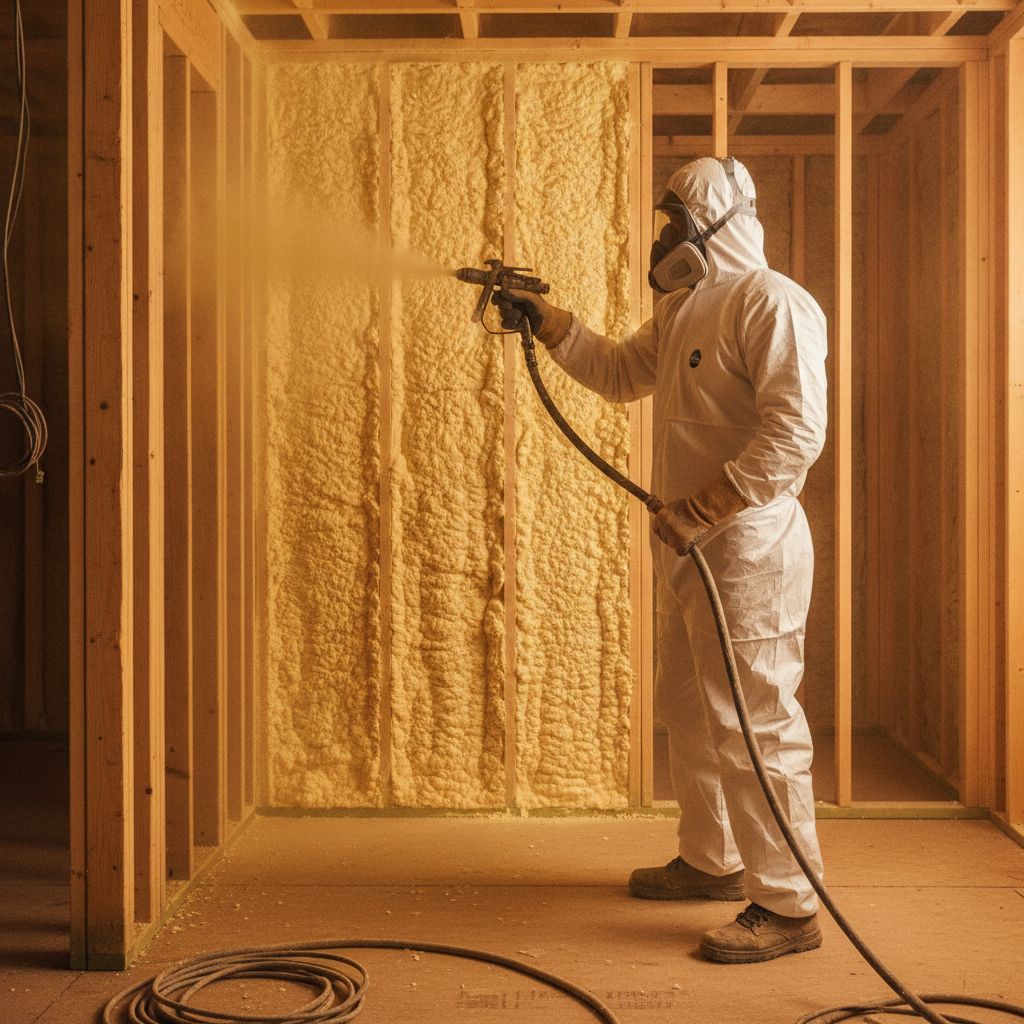
Professional plural-component proportioners actively heat both component lines to a matched, monitored temperature and maintain balanced pressure electronically throughout the job — correcting for cold weather, hose length, and viscosity changes in real time. A DIY kit's cylinders rely on their internal pressure and ambient temperature alone; there's no active correction if the garage is 45°F instead of the kit's rated application-temperature range, and both components' viscosity — and therefore the actual delivered ratio — shifts with temperature in ways the fixed cylinder design can't compensate for.
This is the direct, practical version of the off-ratio problem covered on the Off-Ratio & Improper Cure Science page, just at consumer scale: a DIY kit used outside its rated temperature range, or with an already-degraded cylinder, is more likely to deliver uneven ratio than a monitored professional proportioner.
Where a DIY Kit Is a Reasonable Choice
For small, well-defined air-sealing tasks — rim joists, small gaps around penetrations, a single crawlspace access hatch — a correctly used DIY kit within its rated temperature range can produce a perfectly acceptable result. These are small volumes where even a modest ratio deviation has limited consequence, and the job doesn't require the vapor-barrier or structural performance that depends on precise, consistent application across a large area.
Where Professional Application Is the Right Call
Full wall cavities, roof decks, and any application where the foam is doing vapor-control or structural work need the consistency a calibrated proportioner delivers across the entire sprayed area — not just at the start of the cylinder when pressure is highest. Larger areas also mean a small ratio drift compounds over more square footage, and the cost of a failure (shrinkage, odor, or a vapor-barrier assembly that doesn't perform as designed) is much higher relative to the material cost saved by going DIY.
Key Takeaways
- DIY kits use the same core two-component chemistry as professional spray foam — the difference is ratio-control precision, not the material.
- Professional proportioners actively monitor and correct temperature and pressure; DIY cylinders rely on fixed internal metering with no real-time correction.
- DIY kits are reasonable for small, well-defined air-sealing tasks within their rated temperature range.
- Full cavity, roof deck, or vapor-control applications need the consistency only a calibrated professional system reliably delivers.
Common Questions
DIY vs. Professional FAQs
Real questions people ask before starting a spray foam project.
Related Topics
Open-Cell vs. Closed-Cell Chemistry
The polyurethane chemistry that separates open-cell and closed-cell spray foam, and what it actually means for performance.
Read moreR-Value & Real-World Thermal Performance
How spray foam's R-value is measured, why lab and field numbers diverge, and what actually drives thermal performance in a real assembly.
Read moreWhy Spray Foam Becomes a “Red Flag” — The Reputation Science
The building-science reasons some spray foam jobs turn into resale, insurance, and mold problems — and why it almost always traces back to installation, not the material.
Read more
Ready to Talk to a Certified Installer?
Get matched with a vetted spray foam installer from CCA's network — free, no obligation, and grounded in the same building science you just read.